 | From the Editor's Desk
The empty office: what we lose when we work from home For decades, anthropologists have been telling us that it's often the informal, unplanned interactions and rituals that matter most in any work environment. So how much are we missing by giving them up?
In the summer of 2020, Daniel Beunza, a voluble Spanish social scientist who taught at Cass business school in London, organised a stream of video calls with a dozen senior bankers in the US and Europe. Beunza wanted to know how they had run a trading desk while working from home. Did finance require flesh-and-blood humans?
Beunza had studied bank trading floors for two decades, and had noticed a paradox. Digital technologies had entered finance in the late 20th century, pushing markets into cyberspace and enabling most financial work to be done outside the office - in theory. "For $1,400 a month you can have the [Bloomberg] machine at home. You can have the best information, all the data at your disposal," Beunza was told in 2000 by the head of one Wall Street trading desk, whom he called "Bob". But the digital revolution had not caused banks' offices and trading rooms to disappear. "The tendency is the reverse," Bob said. "Banks are building bigger and bigger trading rooms."
Why? Beunza had spent years watching financiers like Bob to find the answer. Now, during lockdown, many executives and HR departments found themselves dealing with the same issue: what is gained and what is lost when everyone is working from home?
Continued here
TradeBriefs: Newsletters for Decision-Makers!
Advertisers of the day
Emeritus: PG Diploma in Innovation & Design Thinking online program | Accepting applications - Starts on June 30, 2021
Emeritus: PG Diploma in Digital Business by Emeritus | Accepting Applications - Starts on June 30, 2021
Our advertisers help fund the daily operations of TradeBriefs. We request you to accept our promotional emails.
Want the newsletters, without the promotional mailers?
Get an (ad-free) subscription to TradeBriefs Premium for just $2 per month.
|
LifeLife
� LifeLife | � |  | LifeLife | � | | LifeLifeLifeLifeLifeLifeLifeLifeLifeLifeLifeWorkWorkWorkWorkWorkWorkWorkWorkWorkWorkWorkWorkWorkWork TradeBriefs Publications are read by over 10,00,000 Industry Executives |

If this mailer does not render correctly, please enable images or view online Advertise
Unsubscribe |
  
CEO Picks - The most popular editorials that have stood the test of time!
Are monopolies good? Peter Thiel's hypothesis Peter Thiel (of Paypal founding and Facebook investment fame) has argued in his book, 'From Zero to One' that only monopolies like Google can afford the long-term focus and cash drain required to really invest in innovation. He adds that competition causes companies to rush towards mediocrity, as they try to outprice each other or only incrementally improve offerings. In this article, the New York Times makes a similar case. It's interesting that a democratic platform like the internet is creating 'winner-takes-all' companies like Google, Facebook and Amazon. Many of these companies have managed to create network effects (more people joining Facebook makes it more valuable to existing users, so they don't move elsewhere) to become monopolies. Now, the good thing is that they are very aware that the pace of new technology is such that they could get wiped out unless they invest their excess cash in tomorrow's technologies and do it faster and better than the next startup that could upend them (case studies include Nokia and Blackberry). So, in effect, unlike the monopolies of the past which were created through control of licenses and natural resources, tech monopolies are monopolies due to consumer choice and consumers will choose whatever's best for them. Peter Thiel (of Paypal founding and Facebook investment fame) has argued in his book, 'From Zero to One' that only monopolies like Google can afford the long-term focus and cash drain required to really invest in innovation. He adds that competition causes companies to rush towards mediocrity, as they try to outprice each other or only incrementally improve offerings. In this article, the New York Times makes a similar case. It's interesting that a democratic platform like the internet is creating 'winner-takes-all' companies like Google, Facebook and Amazon. Many of these companies have managed to create network effects (more people joining Facebook makes it more valuable to existing users, so they don't move elsewhere) to become monopolies. Now, the good thing is that they are very aware that the pace of new technology is such that they could get wiped out unless they invest their excess cash in tomorrow's technologies and do it faster and better than the next startup that could upend them (case studies include Nokia and Blackberry). So, in effect, unlike the monopolies of the past which were created through control of licenses and natural resources, tech monopolies are monopolies due to consumer choice and consumers will choose whatever's best for them.
However, the above theory is not without its critics. Here is a list of problems with the theory that monopolies are good and that competition is for losers. |
| � | � | | |
A new model for democracy?  So, you have an idea to fix a problem in your city? Maybe, it's potholes, or a cleanliness drive, or a project that reduces pollution. What if, you could put this up on a site and attract funding for it and solve it on your own. That's precisely what a bunch of social designers in Finland did with Brickstarter a few years ago. Imagine if this idea could be further extended, where instead of your local government allocating tax money, ordinary citizens could identify problems, suggest solutions and then allocate their tax dollars towards the projects they identify with the most! True democracy in action? The government knows exactly what the people want, at all times, and plays more of an enabler role. Such a radical new way of looking at democracy is what author Steven Johnson suggests in his book - Future Perfect. Today's technology does provide us the opportunity to experiment with new forms of community development. This is especially critical in large developing nations, where top-down planning often runs into vested interests. So, you have an idea to fix a problem in your city? Maybe, it's potholes, or a cleanliness drive, or a project that reduces pollution. What if, you could put this up on a site and attract funding for it and solve it on your own. That's precisely what a bunch of social designers in Finland did with Brickstarter a few years ago. Imagine if this idea could be further extended, where instead of your local government allocating tax money, ordinary citizens could identify problems, suggest solutions and then allocate their tax dollars towards the projects they identify with the most! True democracy in action? The government knows exactly what the people want, at all times, and plays more of an enabler role. Such a radical new way of looking at democracy is what author Steven Johnson suggests in his book - Future Perfect. Today's technology does provide us the opportunity to experiment with new forms of community development. This is especially critical in large developing nations, where top-down planning often runs into vested interests. |
|
| � | | |
Highlighted Story
Discount retailers TJX, Ross stage a comeback as shoppers crave 'treasure hunting' for clothes again  Any doubts about whether shoppers would return to discount retail stores to rummage through racks in the hunt for bargains were crushed this week when TJX Companies and Ross Stores reported their first-quarter earnings. Any doubts about whether shoppers would return to discount retail stores to rummage through racks in the hunt for bargains were crushed this week when TJX Companies and Ross Stores reported their first-quarter earnings.
Both companies' sales surged past analyst estimates, as consumers started packing back into their stores to look for new outfits, shoes, luggage and home goods as pandemic-induced lockdowns eased.
TJX and Ross cited a pent-up demand from shoppers, many of whom have been armed with extra stimulus dollars in recent months, but also a desire among many people to still look for good deals. So-called treasure hunting in stores could be something that many consumers end up craving more than they did before the Covid health crisis.
"We believe the appeal of our entertaining, treasure-hunt shopping experience gives consumers a compelling reason to shop us," TJX CEO Ernie Herrman said in an earnings conference call. "In-store shopping is not going away." |
|
| � | | |
Norway wants to lead on climate change. But first it must face its legacy of oil and gas.:format(webp)/cdn.vox-cdn.com/uploads/chorus_image/image/68674539/GettyImages_508088155.0.jpg) An expert explains Norway's climate change paradox. An expert explains Norway's climate change paradox.
Norway's ambition to be an international leader on climate change is at odds with its status as one of the world's largest oil and gas exporters.
In 2019, the country was 15th on the list of the world's top oil-producing countries, according to provisional data from the International Energy Agency, and ranked eighth in the world for natural gas production, behind Australia but ahead of Saudi Arabia.
The bulk of revenue from Norway's oil and gas production is kept in a sovereign wealth fund, which was created to keep the money for the Norwegian people and future generations. The fund, which has amassed $1 trillion since its inception in the 1990s, is a source of stability for the nation in times of economic instability, like the coronavirus pandemic.
In December, Norway's Supreme Court ruled against environmental activists who sued the government because they felt oil-licensing permits granted in the Arctic threatened their right to a clean environment under the country's constitution. The decision will now pave the way for more drilling in the Arctic.
Experts refer to this as Norway's "paradox": Norway wants to be at the forefront of international efforts to address climate change, yet it continues to rely on heavily polluting fossil fuel extraction for continued economic prosperity. |
|
| � | | |
The Inequality Virus: Global Report 2021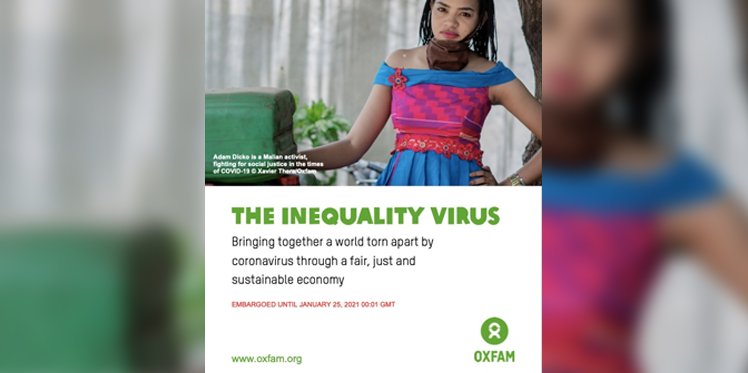 It's not a good time for those who believe in the trickle-down theory of wealth. Here's a wild statistic: The 26 richest people on earth in 2018 had the same net worth as the poorest half of the world's population, some 3.8 billion people. The pandemic has made it worse. Rising inequality means it could take at least 14 times longer for the number of people living in poverty to return to pre-pandemic levels than it took for the fortunes of the top 1,000, mostly White male, billionaires to bounce back. About $7.6 trillion of individuals' wealth sits in offshore tax havens, and if tax were paid on the income that this wealth generates, an extra $190 billion would be available to governments every year |
|
| � | | |
TradeBriefs Publications are read by over 10,00,000 Industry Executives |

| View online | Your support of promotional mailers like these (upto 2 per day) helps us keep the TradeBriefs newsletter free for you. Still wish to Unsubscribe? For inquiries/unsubscribe issues, Contact Us |
NUS Business School's FinTech: Innovation and Transformation in Financial Services programme | Accepting Applications | | | | | | FinTech: Innovation and Transformation in Financial Services | | | | Why should you enrol for this programme? | | With the help of evolving financial technologies, organisations of all sizes are innovating how they conduct business and manage transactions, as are individuals who rely on this tech in their everyday life. Understanding the modern technologies that have transformed the banking and financial ecosystem better enables you to innovate for your organisation's financial products and services. | | | | | |  | | DURATION | | 2 Months, Online 4-6 hours per week | | | | | | | | | | | | In the FinTech: Innovation and Transformation in Financial Services programme, offered by NUS Business School, you will gain a deeper knowledge of the innovations impacting the financial services sector as well as the global trends and regulations of FinTech and how organisations can use this information to make informed decisions and improve profitability and performance. | | | | | As you work through application assignments in the FinTech Playbook, you will learn how to: | | ● | Delineate the impact of emerging technologies in the growth of the financial services sector | | | ● | List key FinTech innovations | | | ● | Understand how to apply FinTech innovations in finance | | | ● | Explain the emerging applications in FinTech like alternative lending and payments | | | ● | List the risks and challenges of using FinTech innovations | | | ● | Show the global trends in FinTech and its regulations | | | ● | Explain key considerations when using and applying FinTech | | | ● | Apply FinTech innovations to design FinTech solutions | | | | | Is This Programme Right for Me? | | If you want to expand your skills and expertise to improve product offerings, including consumer and commercial goods and services, customer experience and technology development for your organisation, this programme is right for you. Roles of participants may include, but are not limited to: | | ● | C-Suite Business Leader | | | | | | | | | ● | Financial Analyst or Planner | | | ● | Wealth Advisor or Consultant | | | | | Flexible payment options starting from USD 672 available now. | | | | | NUS Business School is collaborating with online education provider Emeritus to offer a portfolio of high-impact online programmes. Working with Emeritus gives NUS Business School the advantage of broadening its access beyond their on-campus offerings in a collaborative and engaging format that stays true to the quality of NUS Business School. Emeritus' approach to learning is based on a cohort-based design to maximise peer-to-peer sharing and includes video lectures with world-class faculty and hands-on project-based learning. | | EMERITUS Institute of Management | Committee for Private Education Registration Number 201510637C | Period: 29 March 2018 to 28 March 2022. | | | | 
|
|
|
|
|
|
|
|
|
|
|
|
|
|
|
|
|
|
|
|
|
|
|
|
|
|








/cloudfront-us-east-2.images.arcpublishing.com/reuters/NMCY6HSDRRLH3PZGHT42MAV524.jpg)